CIS Benchmarks and Vulnerability Management: From Baseline to Validation
Why I Revisited It
I earned Security+ and CySA+ earlier in my career. I still revisit the material because these concepts show up in endpoint, server, cloud, vulnerability-management, and incident-response work.
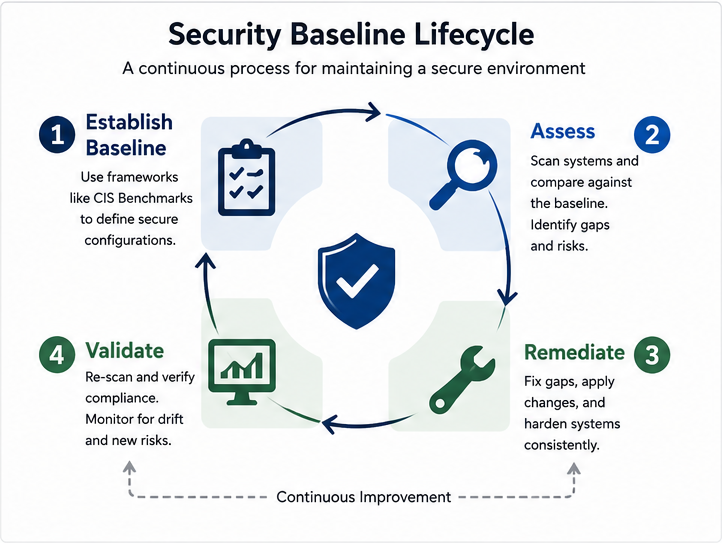
Secure configuration and vulnerability management stood out in this review. I use the same sequence for both: define the expected state, identify gaps, prioritize them, remediate them, and verify the result.
Secure Baselines and CIS Benchmarks
A security baseline defines the expected configuration. NIST describes a baseline configuration as a reviewed and agreed set of specifications used as the basis for future builds, releases, and changes [1].
CIS Benchmarks provide prescriptive configuration recommendations for specific technologies [2]. They cover operating systems, cloud platforms, network devices, databases, applications, and other commonly deployed technologies.
Benchmark guidance still requires engineering judgment. CIS warns that Level 2 recommendations can adversely affect an organization if implemented without appropriate care [3]. Before applying a setting, I want to know what it changes, what depends on it, whether an exception is needed, who owns the exception, and when it will be reviewed.
Configuration Findings and Vulnerabilities
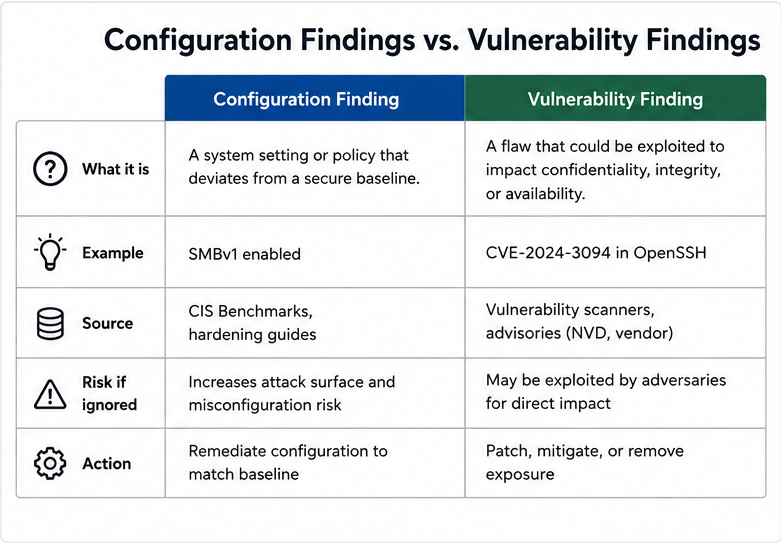
A configuration finding asks whether a system matches an approved baseline. A vulnerability finding asks whether software, firmware, or a service contains a known flaw or exposure.
CIS-CAT Pro Assessor compares target-system settings with CIS Benchmark recommendations and reports conformance [4]. NIST describes enterprise patch management as identifying, prioritizing, acquiring, installing, and verifying patches, updates, and upgrades [5].
A patched system can still be misconfigured. A hardened system can still run vulnerable software. Both need to be part of the same review.
Prioritization Needs Context
CVSS is useful, but it is not a risk score. FIRST states that the CVSS Base Score measures severity, not risk, and should not be used by itself for patch prioritization [6].
I prioritize with additional context: active exploitation, external exposure or reachability, asset criticality, business impact, and effective compensating controls.
CISA recommends using the Known Exploited Vulnerabilities Catalog as an input because it identifies vulnerabilities with evidence of active exploitation [7]. Two findings with similar CVSS scores can warrant different response times once that context is added.
Validate the Change
Remediation is not complete until the result is checked. NIST includes verification in enterprise patch management [5].
After a configuration change, reassess it. After a patch, rescan or otherwise verify the affected state. If an exception is accepted, document the reason, owner, and review date.
CIS-CAT and similar tools can automate some configuration verification [4]. The useful output is evidence that the intended state was reached.
Monitoring continues after validation. NIST's security-focused configuration-management guidance emphasizes maintaining and monitoring configurations while supporting required business functionality [8]. That is where configuration drift enters the workflow.
Takeaway
I get more from certification review when I work through the operational decisions instead of only rereading definitions. That means asking how I would harden a system, prioritize a finding, and verify the change.
The review reinforced three habits: define the expected state, prioritize gaps with context, and verify the result. Those habits apply whether the finding comes from a CIS Benchmark assessment, a vulnerability scanner, or another security control.
The views expressed here are my own and do not represent any employer or organization.
References
[1] NIST CSRC Glossary — Baseline Configuration
[2] Center for Internet Security — CIS Benchmarks
[3] Center for Internet Security — CIS Benchmarks FAQ
[4] Center for Internet Security — CIS-CAT Pro Assessor
[5] NIST SP 800-40 Rev. 4 — Guide to Enterprise Patch Management Planning
[6] FIRST — CVSS v4.0 User Guide
[7] CISA — Known Exploited Vulnerabilities Catalog
[8] NIST SP 800-128 — Guide for Security-Focused Configuration Management